
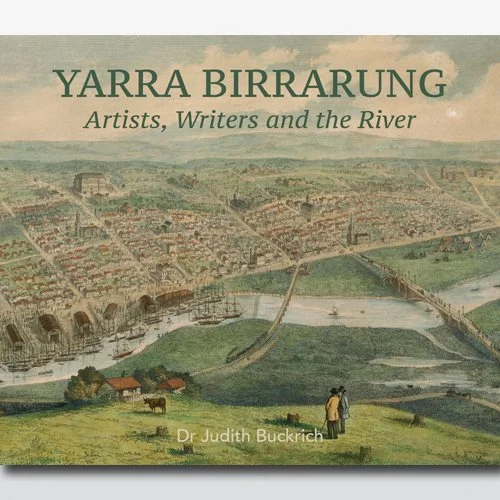
Yarra Birrarung: Artists, Writers and the River
Early on the book describes the Kulin world that was irrevocably disrupted by European invasion, and this establishes an ongoing theme of appreciation coupled with loss. Loss of ecological diversity continues hand in hand with detailed accounting of the meaning this significant body of water holds for humans along its course.
READ REVIEW
↓
Yarra Birrarung: Artists, Writers
and the River
JUDITH BUCKRICH | 2024
Melbourne’s relationship with the Yarra River has been defined for decades by what you can do on, in, and with the river. This new history of the river, now also called by its ancestral name, Birrarung, explores this relationship. Boating, competitive rowing, diving and swimming are some of the joys associated with this well-known river. Swimming has gained traction recently though the global Swimmable Cities movement, which seeks ecological goals through a human-centered framework.
In her history Yarra Birrarung: Artists, Writers and the River Judith Buckrich details the eras past when bathing and swimming were popular along the river from the mid-nineteenth century and into the twentieth, until the inner-city sections became too polluted. Men bathed naked in 1844, for example, until city by-laws prohibited daytime bathing and private floating baths were erected. Though the text doesn’t describe if men and women bathed separately, it’s clear that non-Indigenous Melbournians had easy access to the river as one among several leisure spaces.
In 1910 folks were still swimming in Birrarung, including Harry Houdini during the Melbourne leg of his Australian tour. Leaping from Queens Bridge on a 38-degree February day in front of 20,000 spectators, the magician removed 11 kilograms of chains and handcuffs before surfacing four minutes later, triumphant.
A real strength of the book is bringing together moments of interest like this with many excellent photographs and artworks. The book and an accompanying exhibition at the Royal Historical Society of Victoria (on display in 2025) present the first comprehensive illustrated history of Birrarung from before European settlement to the present day. Illustrations are essential to tell a 200-year story, and the lives of the creatives who have lived and worked along the river are worth picturing.
Early on the book describes the Kulin world that was irrevocably disrupted by European invasion, and this establishes an ongoing theme of appreciation coupled with loss. Loss of ecological diversity continues hand in hand with detailed accounting of the meaning this significant body of water holds for humans along its course.
For example, thousands of recently arrived colonists spent their first night in Australia on the south bank of Birrarung. In just the first four months of 1852, 55,000 passengers from 619 ships jostled for space on the banks of the river as the population of the city exploded. Melbourne’s population boom would continue exponentially once gold was found. Canvas Town, between Princes Bridge and Emerald Hill, accommodated many until they found more secure lodgings. Living near the river has been contested ever since.
Two chapters of this book are dedicated to the ways the river divides. Questions of public policy, how much access to the river and for whom, are still asked today. W M K Vale, member for West Ballarat, put it compellingly in the 1860s: ‘The real question was whether the banks of the Yarra should be conserved for the residences of a few wealthy men, or whether they should afford the means of employment for the large population settled at Collingwood and Richmond. It was a battle between the possessors of 500 villa residences and a population of 15,000 or 20,000’ (p. 130). The idea isn’t more fully explored, and this is a shame, but it does set the scene for short descriptive histories of the river-side suburbs of Kew, Bulleen, Heidelberg, Ivanhoe, and Eaglemont.
Buckrich delves into human intervention on the river, such as its changing boundaries and its use for Melbourne’s water supply until 1857. The completion of the Yan Yean Reservoir on a Birrarung tributary – the Plenty River – provided a cleaner source of water, and today still supplies a percentage of the city’s drinking water. In the early decades, though, regular outbreaks of typhoid each summer were common until the sewer was completed in 1901. Indeed, Melbourne’s infant mortality rate exceeded that of London’s until the 1890s. Smellbourne, as it was known, accepted germ theory by the 1890s, but pollutants from industries like tanning and soap-making still flowed into the river.
Even observers in the 1880s tried to recall what the place looked like before European invasion. In 1888 Garryowen thought very tall trees must have grown at Queen’s Wharf, offering ‘a spectacle for which eyes could now seek in vain’ (p. 68).
As a predominantly visual history, further chapters dedicated to artists including the Heidelberg School and twentieth century artists’ colonies like Montsalvat and Bridge House, add depth to black and white photographs. These stories reveal a long history of the river weaving through creative communities where people chose to live differently, many following in the footsteps of Impressionists like Clara Southern (1860-1940), moving to places like Warrandyte for isolation and inspiration.
Drawing from library and gallery collections, as well as private archives, the images in this book are one of its key achievements. The text, while thoroughly researched and engagingly written, focuses on people and place rather than a single narrative. This is a pleasurable book to dip in and out of, with a traditional coffee table format. The reader will be left in no doubt, however, that Birrarung has been damaged and the restoration process is far from complete.
Yarra Birrarung: Artists, Writers and the River is published by Melbourne Books.
Reviewer: Nikita Vanderbyl (PHA Vic & Tas)
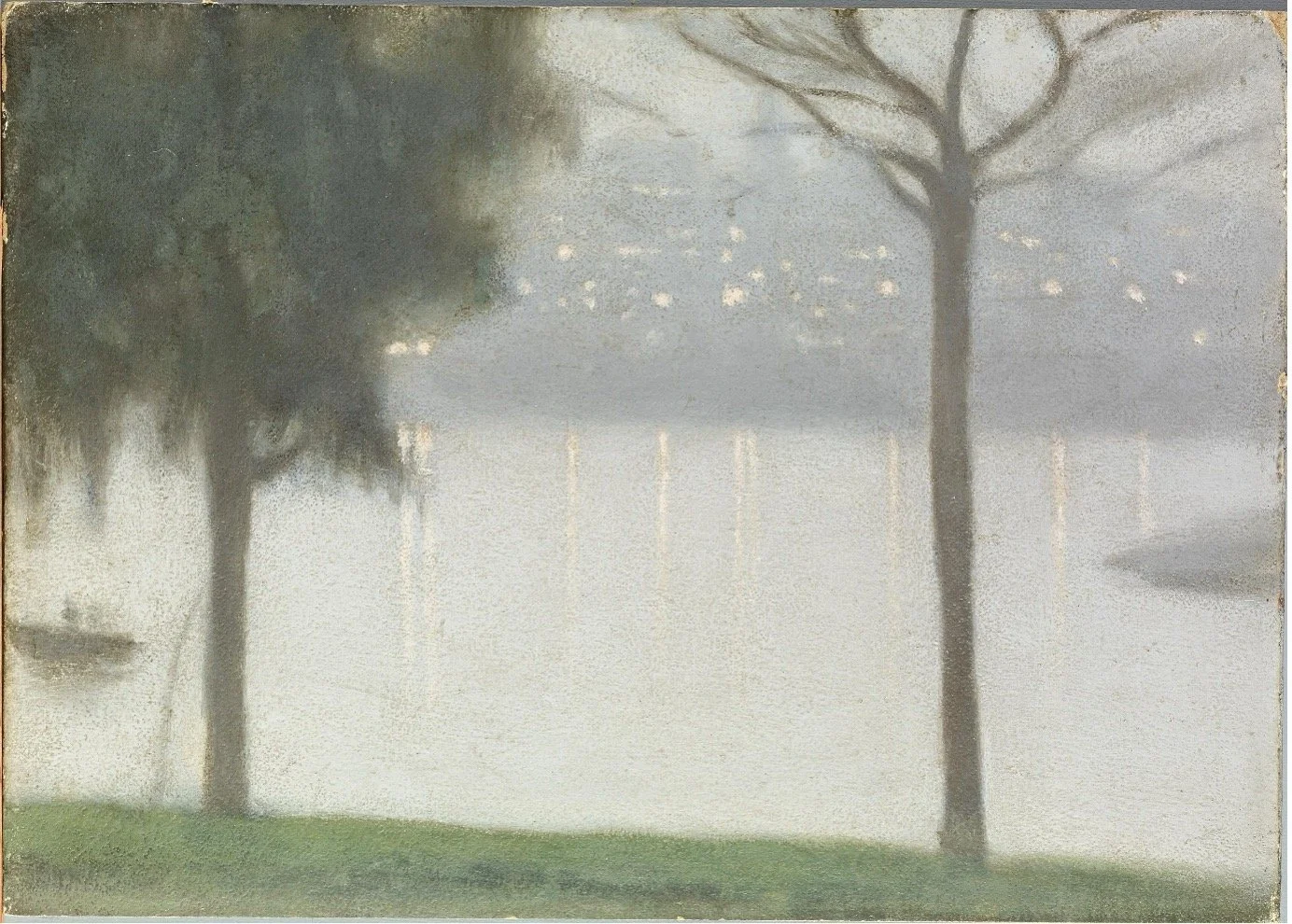
Clarice Beckett, Across the Yarra (c. 1931)
National Gallery of Victoria, Melbourne