
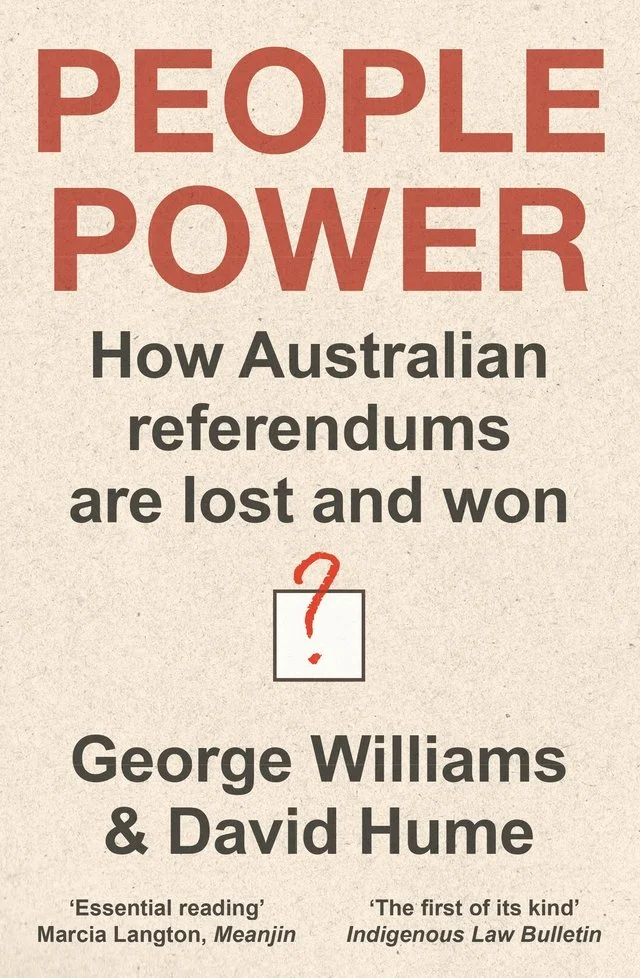
People Power: How Australian referendums are lost and won
This history of referendums shows that Australian voters are reluctant to change the Constitution unless they are persuaded it is in the nation’s interest to do so. They are suspicious of proposals that seem more likely to benefit the political class than the whole population. The requirement to get a majority of the states voting in favour of a proposal also makes it difficult to introduce any measure seen to weaken the Senate or states’ rights. Yet, with good proposals and processes, referendums can succeed. And it is in the interest of our democracy that they do.
READ REVIEW
↓
People Power: How Australian referendums are lost and won
George Williams and David Hume | 2024
What a shame Anthony Albanese did not read the first edition of this book (2010) before he persisted with the Voice referendum, once it became clear it lacked bipartisan support. He would have learned that it’s essential to have that consensus, as well as to get both the proposal and the process right before asking the people to change the Constitution.
Mr Albanese would be well advised to pick up People Power now to reflect on the 2023 failure and to consider next steps for the constitutional reform that the Australian federation needs, including how a second vote on becoming a Republic might be shaped in the 21st century.
More immediately, as the nation grapples with disunity in the shadow of the Bondi massacre, he might revisit the words of an earlier Labor leader, Doc Evatt. On 20 September 1951, as Leader of the Opposition, Evatt addressed 1,200 people in Esplanade Hall, Bondi. He was speaking against the proposal to change the Constitution to allow the banning of the Communist Party. Evatt opposed the referendum proposal because he wanted to protect liberty and free speech. We need again to ensure that our government and parliaments do not damage these fundamental ideas in their battle against unlawful behaviour and extreme ideologies.
George Williams and David Hume have examined the record of Australian referendums to show why only 8 of the 45 proposals put to the people have succeeded. This mechanism for changing the Constitution is the bedrock of our democracy. We must get it right, the authors argue, because constitutions do need changing to remain relevant. They point to the fact that the federal system created in 1901 is proving inadequate, for example, in dealing with the new realities of water-sharing across state borders. We cannot afford, constitutionally speaking, to be the ‘frozen continent’, as Geoffrey Sawer put it in 1967.
The first half of the book is a detailed account of how referendums work. In the chapter on campaigns, it is revealed that there is no requirement for either side in the debate to be truthful. How damaging this can be was manifest in the most recent campaign about the Voice. That referendum prompted the second edition of People Power.
Before the chapter setting out the ‘long road to the Voice referendum’, the authors detail 8 previous referendums (including the failed 1951 vote on banning the Communist Party). This makes fascinating and, in the case of the 1967 proposal to grant the Commonwealth power to make laws with regard to Aboriginal peoples, uplifting reading. The 1967 ‘yes’ vote was 90.77 per cent; the need for official recognition of Aboriginal people had been building since the late 1920s.
The discussion of the failed Republic referendum in 1999 reinforces the message that strong political and public support is essential well before the proposal is put to the people. It also reveals the disheartening reality that many Australians do not have a good understanding of the Constitution or our governmental systems and are easily persuaded to vote ‘no’ if they don’t know, rather than to find out more. Opposition leader Peter Dutton exploited this ignorance and apathy in 2023.
The detail in this book is worth engaging with, but its main messages can be found in the last two chapters:
Questions need to be clear and simple.
Bipartisan support is essential – the opposition has tremendous power in referendums, as Australians have shown themselves reluctant to support reform in the face of political division.
The current system incentivises misinformation and polarisation.
Hence, we need a new model for progressing constitutional reform that generates good proposals, educates the community, and brings forward ideas with broad popular and political support. The authors finish up with ways of ‘Getting to Yes’. They offer solutions that our politicians and educators would do well to embrace, so that the long absence of successful constitutional change in Australia does not become a permanent barrier to worthwhile reform.
People Power: How Australian referendums are lost and won is published by UNSW Press.
Reviewer: Francesca Beddie, PHA (NSW & ACT)