The Prime Minister’s Potato and Other Essays
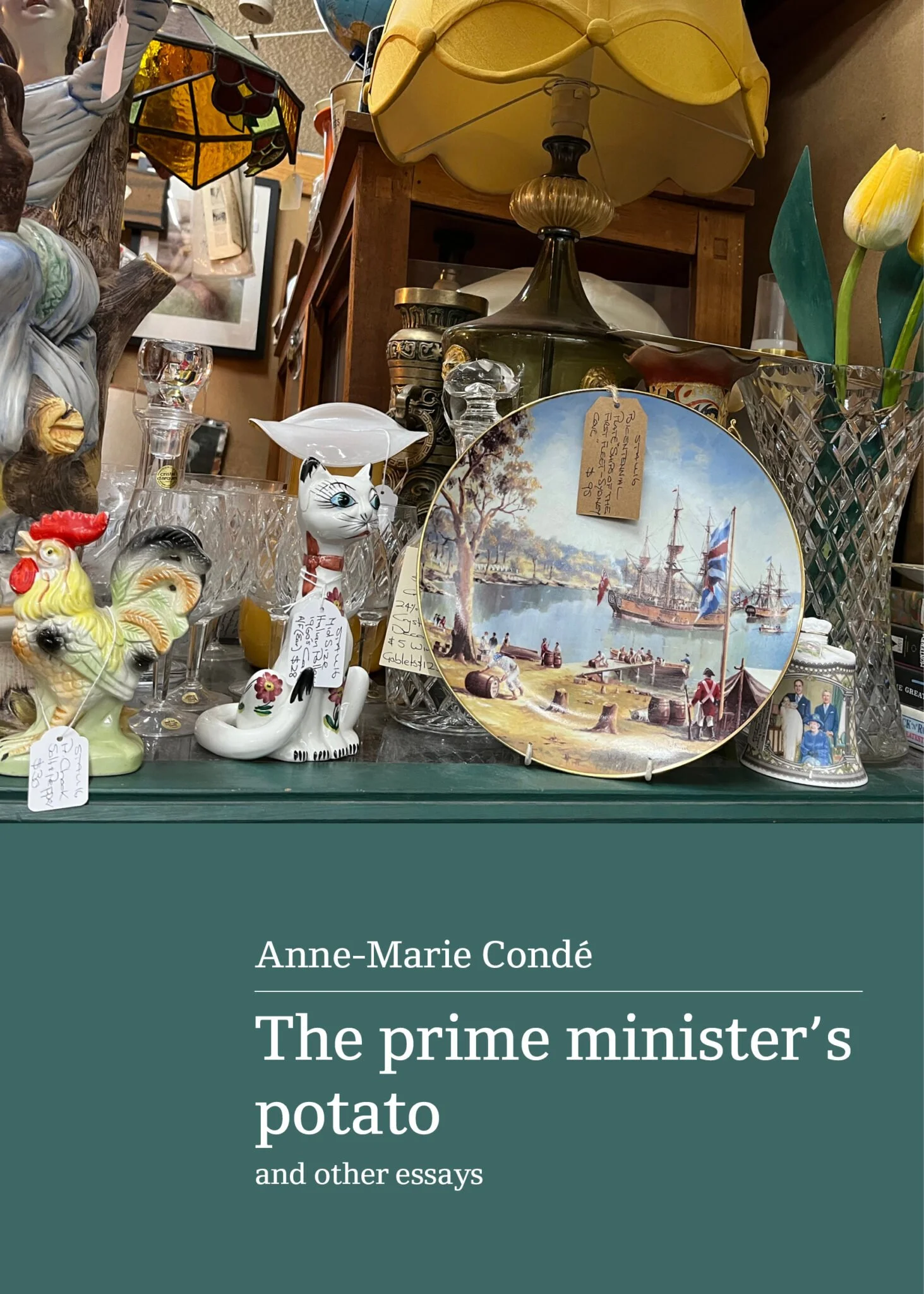
In this book you will find a potato, a pipe, and a telegram. In the hands of a skilled historian, these ordinary objects deliver extraordinary stories about Australia and Australians. This book is a testament to Condé’s curiosity and skills as a historian and curator.
READ REVIEW
↓
THE PRIME MINISTER’S POTATO & OTHER ESSAYS
Anne-Marie Condé | 2025
I have been trying to work out why I like this book so much. Which is not to say that I did not expect to like it, but I liked it more than I anticipated.
My career overlapped with the author’s for about 18 months when we both worked as curators at the National Museum of Australia. Anne-Marie Condé has gone on to work at the National Archives of Australia and the Museum of Australian Democracy and previously worked at the Australian War Memorial in Canberra. This book of essays is a collection of the stories she has unearthed from the archives and objects she came across in the course of her employment.
In this book you will find a potato, a pipe, and a telegram. In the hands of a skilled historian, these ordinary objects deliver extraordinary stories about Australia and Australians. This book is a testament to Condé’s curiosity and skills as a historian and curator. It is the result of what author Emily Maguire calls ‘promiscuous curiosity’.[1]
Several of the essays in the book draw on the author’s experience of living in ‘Secheron’, a historic house in Hobart’s Battery Point. Like a skilled embroiderer, Condé overlays the historical with the personal to tell us how the lives of Charles Darwin (author of On the Origin of the Species), George Frankland (surveyor-general of Tasmania from 1828 to 1838), and Clive Lord (Director of the Tasmanian Museum and Art Gallery from 1923 to 1933) intersect with her family’s. This is not an exercise in name-dropping, but a reminder of how in Australia, and particularly Tasmania, there are fewer than six degrees of separation between us.
The third essay titled ‘The Telegram’ was one that I initially bypassed because I knew it would be about war and I wasn’t in the mood for that. This is something that I try not to do in a collection of essays or short stories, because the curator in me believes that the author has chosen to put the stories in a particular order for reasons that will become apparent as I read them in that order. When I went back to read ‘The Telegram’, I discovered that war was only the backdrop to the most empathetically realised story about the delivery of a telegram announcing the death of a son and brother to the Garriock family in Balmain, Sydney in 1917. Condé takes us to the doorstep of the house and imagines the mother cooking dinner, the father reading the paper, and the nervous clergyman, who must deliver the telegram, standing on the threshold (p. 35). Thanks to her evocative writing, I was there, at the doorstep, about to witness this moment of agony. It’s an image that will stay with me.
I like the way that Condé talks directly to her readers. In ‘My Brother Clive’ she writes: ‘I am working with some dark materials; I want you to know that’ (p. 23). I like her sense of humour, which appears in delicious sentences such as, ‘there were peals of laughter in the office that day, let me say, at the thought of a potato-induced protuberance in the prime ministerial pocket’ (pp. 177-78). I like her humility: ‘rookie historian that I was, I did not record the conversation’ (p. 122), referring to an interview that she conducted for her history honours thesis. I like the way she articulates the emotions that can arise in archival research and asks the reader to consider some of the ethical issues that historians grapple with, such as subjectivity and speculation. Condé is able to step outside the process and observes for readers: ‘you will notice me at work: leaning in, standing back, applying empathy here, scepticism there, testing the limits of the sources and probing my own subjectivity’ (p. 23). Yes, this is what historians do!
I admire her ability to read between the lines of a letter that has been buried in the archives and try to understand the unwritten emotions of the correspondent. When Condé examines a letter sent to Prime Minister Ben Chifley from a miner in Tasmania who has ‘battled for Labour’, she speculates on what is unintentionally expressed: ‘the things that most matter to him: his work, his family and the labour movement’ (p. 170). Perhaps most of all, I admire Condé’s talent for finding some old postcards in a second-hand shop, buying a bundle and then uncovering the stories and people that lie behind them. For her, ‘becoming deeply immersed in someone else’s life, trying to see the world through their eyes, is my form of meditation’ (p. 170).
Which brings me to my only complaint about this book: the lack of references. I could sense the amount of research that went into writing these essays and the breadth of sources consulted. However, I wanted to dive deeper and see the plethora and type of sources Condé used, with a view to expanding my own research methods in the future. I know that printing pages of endnotes adds to the expense of publishing, and that compiling references is tedious and time-consuming; but for me, it would have enhanced the reading experience to consult the references at the back of the book, or on the publisher’s website. Instead of references or a bibliography, Condé has opted for a ‘further reading’ list, which will likely satisfy readers who are not picky historians.
Nevertheless, I will be recommending this book to my book clubs (yes, plural – I like to read around) for 2026.
The Prime Minister’s Potato and Other Essays is published by Upswell Publishing.
Reviewer: Alison Wishart, PHA (NSW & ACT)
[1] Maguire, Emily, Colin Roderick, Lecture, 2025 broadcast on ABC Radio National Big Ideas, 8 December 2025. https://www.abc.net.au/listen/programs/bigideas/emily-maguire-colin-roderick-memorial-lecture/105871660