
Uprising: War in the Colony of New South Wales, 1838-1844
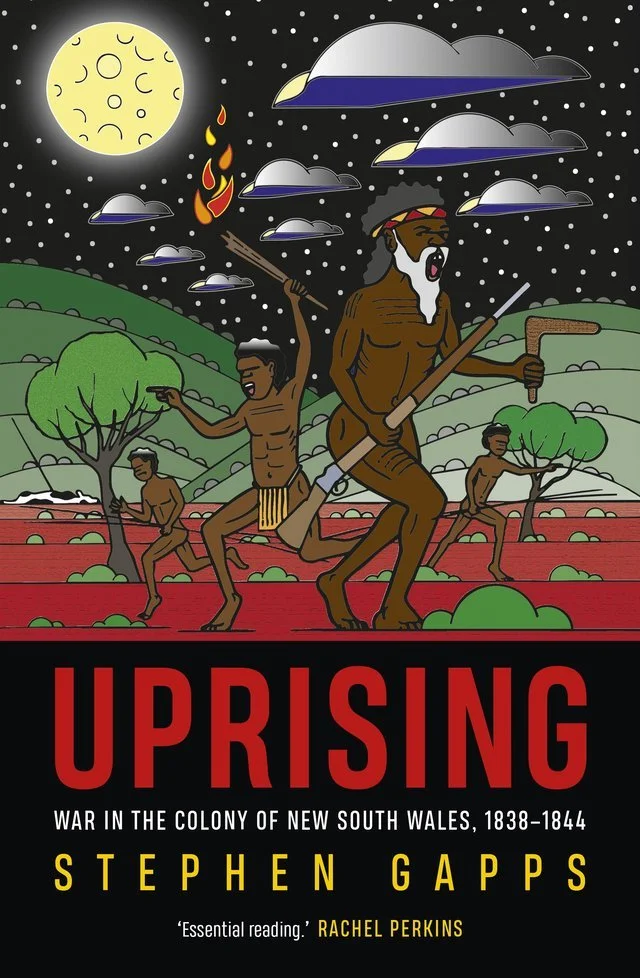
In this third offering about the Australian Wars, Stephen Gapps has again provided an in-depth and well-resourced volume widening the geographic sphere of his previous works… Gapps follows an arc of resistance from the south where the new settlement of Port Phillip (Melbourne) was tenaciously establishing itself, through New South Wales and into the Darling Downs in what is now Queensland.
READ REVIEW
↓
Uprising: War in the Colony of
New South Wales, 1838-1844
stephen gapps | 2025
In this third offering about the Australian Wars, Stephen Gapps has again provided an in-depth and well-resourced volume widening the geographic sphere of his previous works The Sydney Wars (2018) and Gudyarra (2021).
The book is divided into two parts. Part One – Uprising – traces the numerous incidents of frontier violence beginning with the Faithfull massacre in 1838. Geographically, Gapps follows an arc of resistance from the south where the new settlement of Port Phillip (Melbourne) was tenaciously establishing itself, through New South Wales and into the Darling Downs in what is now Queensland. Squatters went beyond the 'limits of location', that is, beyond the boundaries of the nineteen counties to find pasture for their herds of cattle and flocks of sheep; violating and destroying Country cared for and managed by numerous Aboriginal groups. Introduced sheep and cattle destroyed waterholes and crops and encroached upon sacred places important for the maintenance of culture. Traditional foods such as kangaroos and other vital food supplies that were previously abundant became increasingly difficult to obtain; the carefully managed ecosystem became unbalanced. Gapps chooses to treat the Aboriginal offensive thematically; in doing so he effectively underlines the active alliances between Aboriginal groups. The narrative supports a refocus to a broader consideration of frontier violence. Too often, small potted histories of a particular area cocoon incidents of frontier violence, making it seem as though any conflict was an isolated incident when in fact each offensive was part of a larger and well-coordinated alliance of disparate Aboriginal groups.
Part Two – The Counteroffensive – returns to the 1838 Faithfull massacre following the same geographic path plotted in the first section. It chronologically shadows events from the previous section but this time focuses on the toll of guerrilla warfare and its effects on squatters – their stock losses, theft of supplies, destruction of crops and murder of shepherds and stockmen, and their reactions to this offensive. Despite the warning given by the outcome of the Myall Creek massacre case (1838), when seven of the perpetrators were hung for murder, the killing of Aboriginal peoples continued unabated, albeit at a more clandestine level. Throughout the narrative Gapps steadily builds up the tension and fear between squatters and Aboriginal peoples on the frontier. Squatters were unable to attract workers, resulting in the abandonment of many stations or runs (pp. 126-7). This, Gapps describes, was nothing but an all-out war; the Uprising peaked from 1838 to 1844; however, the conflict persisted far beyond the time range treated here. Governor Gipps eventually succumbed to the petitions of the squatters, many of whom were very influential people within the colony at the time. Indeed, a number were magistrates, politicians and ironically, Aboriginal Protectors (p. 181). Gipps eventually sanctioned the establishment of military forts to guard the transport of supplies (p. 212). Together with improvements in firearms, the greater number of horses available and an increasing knowledge of the bush enabled more successful responses to the 'outrages' committed by Aboriginal peoples on the frontier.
This sanguinary narrative concludes with the eventual decimation of Aboriginal peoples. Although overwhelmed by the numbers of squatters in their insatiable search for pastures to grow their herds and profits, Aboriginal peoples never ceded their Country. Not to be readily dismissed is the influence of the British military throughout the process of colonisation of Australia. Tactics used in the Peninsula and Napoleonic Wars, as well as the occupation and colonisation of other countries including India, the West Indies, America and China, for example, underline the use of guerrilla warfare. Gipps was a veteran of these wars, along with Macquarie, Hunter, Brisbane, Darling and Bourke. The military manoeuvres used against Aboriginal peoples were tried and true tactics learnt in these overseas theatres of war. Later, the Native Police Force was formed along military lines, wreaking havoc on the Aboriginal population in Queensland and across northern and Western Australia (p. 217).
In this military history, Gapps provides an in-depth examination of the many incidents of violence perpetrated by both colonists and Aboriginal peoples. He consults an impressive breadth of primary sources including colonial diaries, newspaper articles and government records, as well as interviews with Elders and historians in the field of Australian Wars. The endnotes provide greater insights for the professional historian and enthusiastic reader alike. Indeed, the writing style would suit a wide range of readers, showcasing Gapps' increasing narrative skill. The addition of maps is helpful; they provide a much-valued understanding of place and movement on the frontier. What I admire most about this book is the way in which Gapps has underlined the agency of Aboriginal peoples.
Uprising: War in the Colony of New South Wales, 1838-1844 is published by UNSW Press.
Reviewer: Dr Jennifer Debenham, University of Newcastle and PHA (NSW & ACT)