
Deep History: Country and Sovereignty
The two Bundjalung men who caught the koalas were not behaving on a whim; they were doing what they had been taught by their family and an act developed over thousands of years. An example of deep history in action!
READ REVIEW
↓
Deep History: Country and sovereignty
Ann McGrath and Jackie Huggins (eds.) | 2025
In 1956, two young Aboriginal men were arrested near Ballina in northern NSW while walking along a quiet district road. They were making their way home to Cabbage Tree Island on the lower Richmond River in Bundjalung Country and in their possession were two koalas, one recently killed and the other still alive. The men were arrested for breaching the state faunal laws of the day. Hauled before the local court, the men explained that they had been hunting for food. The koala they killed was to be eaten that day and the other kept for later. In their defence, they said that this is what they and the generations before them had always done. The judge took no notice, handed down a conviction and fine, and directed the surviving koala be taken to a sanctuary on the northern outskirts of Sydney to keep it away from the Cabbage Tree Island community.
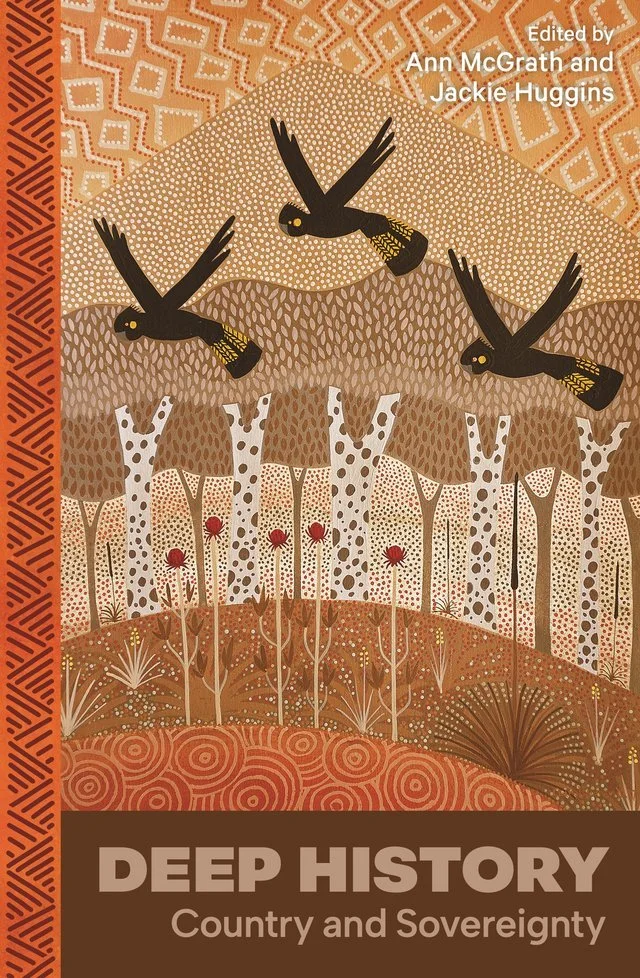
The story, which I found during native title research on the north coast, came to my mind after reading Deep History: Country and Sovereignty, edited by Ann McGrath and Jackie Huggins. Consisting of 5 parts and 12 chapters written by a variety of authors, Deep History explores the enduring attachment of Indigenous peoples to their land and culture in Australia, New Zealand and the Pacific. The book helped crystallise in my mind a clearer definition of the concept of deep history. It is not a matter of history intruding into areas usually the focus of archaeology (a misconception on my part). Rather, deep history is about reframing research to an Indigenous perspective, honouring the contribution of oral knowledge built up over millennia and understanding how contemporary practices, embedded in culture, are expressions of sovereignty and continue to connect Indigenous people to their lands. The two Bundjalung men who caught the koalas were not behaving on a whim; they were doing what they had been taught by their family, an act developed over thousands of years. An example of deep history in action!
My favourite chapter in the collection is Jackie Huggins’ reflections on her connection to Carnarvon Gorge in central Queensland. Professor Huggins, a Bidjara woman, eloquently expresses the strong spiritual dimension of her connection, which has endured despite the impact of colonisation. I was also drawn to Grace Fletcher’s chapter on the ongoing custodianship of Mutthi Mutthi, Barkandji, Ngiyampaa and Tati Tati peoples in south-western NSW over significant water drainage systems. The use of traditional tracking knowledge to gain insight into the 20,000-year-old trackways on Lake Mungo demonstrates the power of Deep History in an academic setting. As Anna Clark notes, it is important that history as a profession adopts approaches such as these to ensure that the stories told are ‘encompassing and inclusive’.
My only criticism of the book is the frequent use of theoretical jargon in some chapters, which may discourage the broader public from diving deeper. Nevertheless, Deep History has given me a thorough understanding of the concept and the importance of respecting Indigenous perspectives when seeking to understand the past and encouraging emerging Indigenous historians to write and tell their own stories. It is a book that I will return to as my work in history and native title continues.
Deep History: Country and Sovereignty is published by UNSW Press.
Reviewer: Michael Bennett (PHA NSW & ACT)