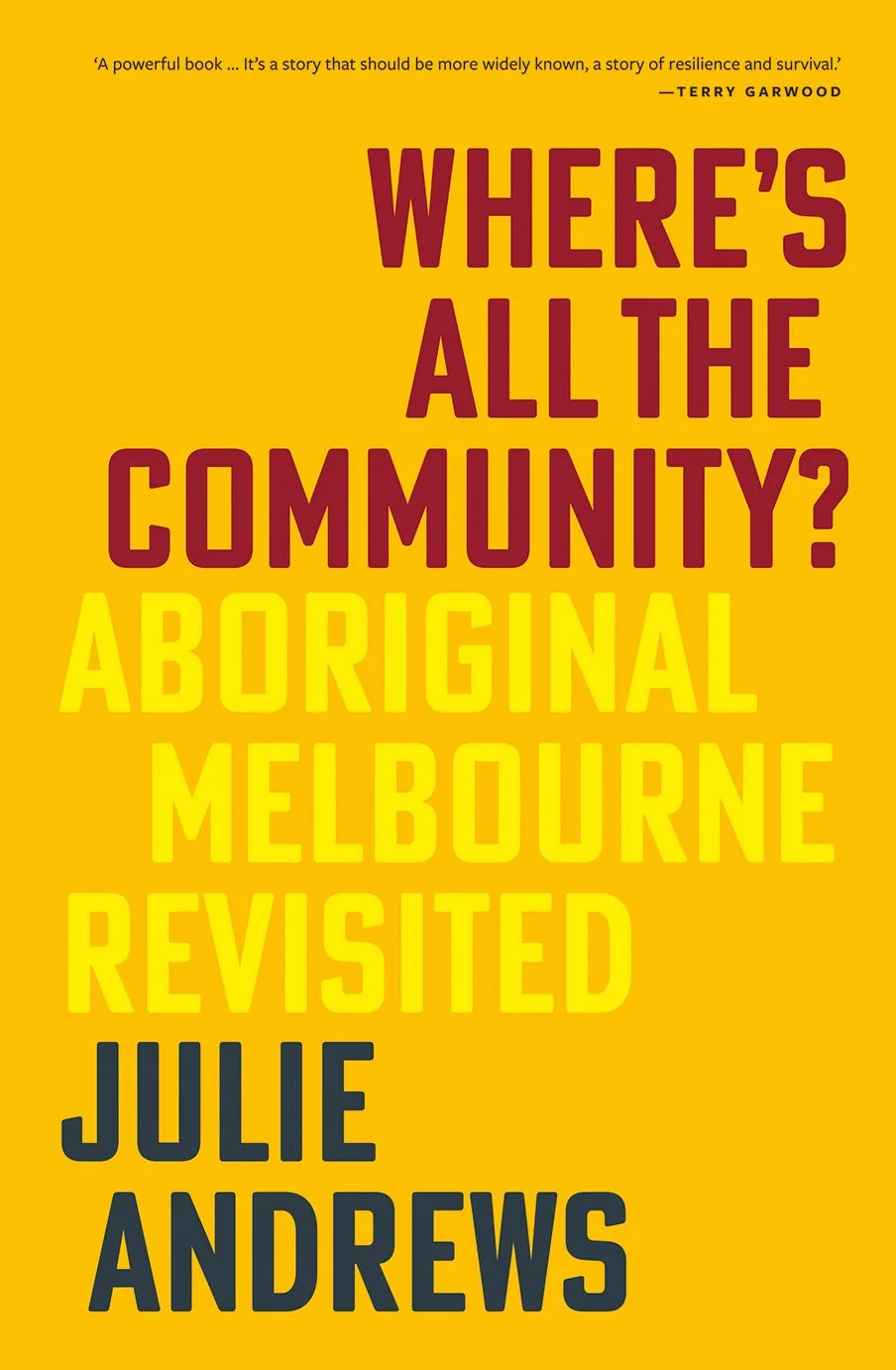
WHERE'S ALL THE COMMUNITY? ABORIGINAL MELBOURNE REVISITED
Andrews states her aims as ‘document the history of Aboriginal Melbourne from within the community; to give voice to the community; and to show how far Aboriginal research and scholarship have come since the 1960s’
READ REVIEW
↓
Where’s All the Community? Aboriginal Melbourne Revisited
Julie Andrews | 2026
A book’s release can be a gentle thing. Potential readers are introduced to the idea of a new book with its appearance on shelves at the local bookseller or in an online newsletter from a publisher. The formal release of Where’s All the Community? Aboriginal Melbourne Revisited in March 2026 was preceded by so much online chat, in-person discussion, and publisher publicity I knew this was a book for which I had to make time in an already hectic reading schedule.
Where’s All the Community? is the product of Professor Julie Andrews, a member of the Briggs family clan of the Yorta Yorta Nation. She has been teaching Aboriginal Studies for approximately 15 years at La Trobe University. Director of the Gabra Biik Wurruwila Wutja Indigenous Research Centre (Indigenous Research), Andrews leads the consultation process with Indigenous communities and industry on research partnership building and raising the prominence of Indigenous-led research.
Andrews’ autoethnographic approach merged with Aboriginal and academic conventions has provided a text grounded in ‘Aboriginal ways of knowing (location of self through family and connection to Country), which are rooted in community knowledge and lived experience’ (p. 3). Andrews explains ‘oral history is the strongest cultural practice that contributes to the survival of Aboriginal Victorians post-colonisation’ (p. 53).
Her personal and academic experience is undeniable as Where’s All the Community? offers a strong and nuanced response to the earlier work of Canadian feminist, historian and anthropologist, Diana Barwick (1963). Barwick’s PhD thesis, 'A Little More than Kin', extracted information from oral histories to gain insights into how Victorian Aboriginal communities functioned. It appears that Barwick treated oral histories as data to be mined by an outside researcher, whereas Andrews positions herself within the community as a participant, not just an observer. However, this book is more than a retort to another’s research. It is a clear account of one woman’s experience of Aboriginal Melbourne and a platform to share an array of others’ opinions and experiences. Where’s All the Community? is more than a structured series of chapters and words printed on a page. The book is evidence of generations of yarning; car trips rich with conversation, and the patience required of fieldwork. Andrews’ approach weaves together substantial primary and secondary research, oral family histories, and an additional 21-oral history interviews.
Andrews clearly states her aims for this book exist as to ‘document the history of Aboriginal Melbourne from within the community; to give voice to the community; and to show how far Aboriginal research and scholarship have come since the 1960s’ (p. 1). The narrow geographical and temporal focus is a strength in the book. It demonstrates how oral histories co-exist with unresolved tensions. Something that colonial archives, and “post-colonial” archives struggle to address.
Her impressive ability to deliver a range of perspectives is a constant presence throughout the book and makes it possible to achieve this aim. Andrews writes in a clear and direct style. Giving voice to a range of people with the use of oral histories, Andrews disrupts the binary of “for and against” that contemporary writings about political community appears to favour. By allowing individuals space on the page to speak of firsthand experiences related to political movements like the 1967 referendum, native title, and opinions about events in mission history, Aboriginal Melbourne becomes an assemblage of experiences, not a text flattened by the need for narrative cohesion.
The potential audience for this book is varied. The repetition in chapters ensures content can be read, or taught, as single chapters. By repeating Gladys Nicholls and Margaret Tucker’s contributions and legacies in Aboriginal community and politics Andrews reinforces narrative threads, such as the work of women in Aboriginal communities, political groups, and families (although separating one group from another appears impossible at times). Andrews writes about childhoods that ‘were a blend of community meetings, meetings with dignitaries and protests’ (p. 73) in moments of travel in the family car.
Andrews does state Where’s All the Community? is a means of teaching younger generations of Indigenous clans about their Aboriginal histories. It also offers valuable critique to researchers in discussions about archives and anthropology. Andrews’ analysis of outsider methodologies enables her to demonstrate the importance of data sovereignty, whereby research conducted by academics finds its way back to the community and the people that most need to be authorities of Indigenous communities’ past. Through the process of sharing her research and findings Andrews ‘afford[s] my participants agency by enabling their voices and lives’ as central to the book. I cannot write on behalf of her participants, however, the chapter ‘Corner to Corner: The Moral Economy of Aboriginal Street People’ is a lesson in an academic and author’s awareness of their power when telling another’s story, especially in association with the complexities of drug and alcohol addiction. The discussion of moral economy and social characteristics of the Parkies in Aboriginal Melbourne taps into larger themes of family, reciprocity, governance, and surveillance. This chapter is done well, with a strong positioning of Andrews as an outsider to this part of Aboriginal community.
There is much in this book to appeal to professional historians. The book is an invitation to others in the Aboriginal community to write their version of Melbourne’s history (p. xxviii). As Andrews explains, it is a history of the Aboriginal community of Melbourne that she grew up in. With a legacy rich in Aboriginal organisational histories and service delivery the book is ‘important to past, present and future generations…to remember that they are walking in their Elders’ footsteps, traversing the same streets when they march for land rights and social justice’ (p.222). I came to this book as a non-Indigenous historian and as a Melbournian, thinking it would change the way I understand the history of suburbs in Melbourne. Instead, this book took me on a journey through Melbourne, to regional Victoria and interstate. In doing so it disrupted what I thought is Aboriginal Melbourne and improved my understanding of local politics, family, genealogy, community, feminism, and culture.
You can listen to an interview with the author via your chosen podcast service or on Literary La Trobe podcast.
Where’s All the Community? Aboriginal Melbourne revisited is published by Black Inc.
Reviewer: Dr Deborah Lee-Talbot, PHA (Vic & Tas)