Read the latest Issue of Circa: The Journal of Professional Historians
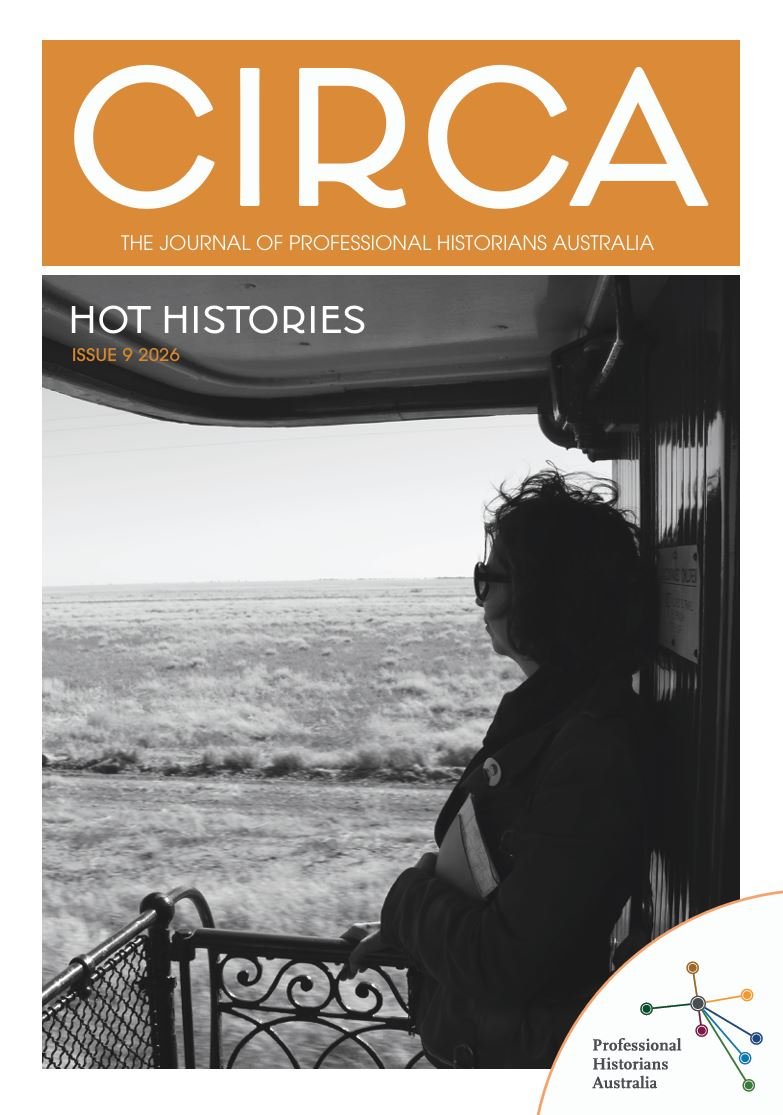
The latest issue of its journal, Circa: The Journal of Professional Historians, is out now. Click here to read the issue.
Co-editors Francesca Beddie and Elizabeth Offer, as well as the Editorial Board, are pleased to present issue 9 of Circa, based on the PHA Hot Histories Conference held in 2025.
With an updated look, Circa continues to explore the practices, work and challenges of professional historians.
This issue of Circa begins with a review of PHA’s most recent Hot Histories Conference held in Darwin. The review is followed by nine peer-reviewed articles that explore a diverse range of topics from the nineteenth century larrikin to the modern use of AI by historians. For an interlude, Jacqui Newling provides a fascinating look at the history of spices and seasonings in colonial Australia, which is based on her keynote speech from the Hot Histories Conference. Following the interlude are four reviews that examine the practice of history.
Read the latest issue of Circa here and feel free to circulate the work of your fellow members far and wide.
We also welcome submissions for the next issue (no. 10) of Circa, set to be published in 2028. To find out more, please visit the webpage.
Circa Essay Prize
The judges of the best peer-reviewed article in Hot Histories, Circa #9 had a difficult job. All the essays were well written, well researched and referenced and all added some vital knowledge to the scholarship of Australian history and its practice.
Their decision was made against the criteria:
encouraging professional practice
showcasing the skills of the professional historian
advocating for history and the protection of historical resources
maintaining the high standards of the profession
Winner
Larrikin pushes: place and space in 19th-century inner Melbourne suburbs by Libby Blamey, PHA Vic & Tas
A wonderful study of urban history. The article demonstrates parallels of larrikinism in today’s issues of youth crime as well as challenging the Australian stereotype of larrikinism.
Although written about Melbourne, it could have implications for all Australian cities. The concept of public spaces and hyper-localism was an interesting highlight of the work, as was the role of girls as audience to the male performance.
The paper was well presented and researched and is an excellent example of how history contributes to an understanding of heritage value.
Highly commended
A new approach to old documents: how historians can critically engage with AI by Deborah Lee-Talbot, PHA Vic & Tas
Deborah Lee-Talbot's essay offered a sophisticated account of how AI could be used to improve access to digitised collections, especially 19th-century sources in handwriting that modern readers have difficulty deciphering. This use of AI has the potential to make records more widely accessible to groups hitherto not able to use historical collections.
The essay kickstarts a conversation that professional historians should pursue about how historians use AI and, as importantly, engage with its development.
An Indigenous history of Parap Camp by Maisie Austin, Charles Darwin University
Maisie Austin’s essay successfully blended lived experience (including wonderful photographs from her personal collection) oral history interviews, archival research and readings from selected secondary sources. Austin has a light touch even when dealing with the most confronting material, including the racist ideas and laws that governed the lives of so many Aboriginal people.
This essay makes a contribution to so many fields, including histories of war, eugenics, sport, housing, multiculturalism and public health. It demonstrates the importance of historical resources held within families, especially Indigenous ones.
World Wide Webs: perspectives on building online exhibitions by Lauren Samuelsson & Srishti Guha (PHA NSW)
Lauren Samuelsson and Srishti Guha offered both intellectual and practical insights into developing and delivering an online exhibition, not only from a curatorial and technical perspective but also the decision-making processes at each point along the way, right through to how to capture feedback and analyse impact.
Importantly, the essay discussed the collaboration between academic and professional historian, acknowledging their different but equally pivotal roles, with the latter having to preserve the integrity of the academic research when transforming it into a public-facing experience to maximise its reach.