Reflecting on thirty years as a professional historian
PHA national president, Jeff Hopkins-Weise, shares reflections from his career as a professional historian in the lead up to PHA’s 30th birthday
Professional Historians Australia (PHA) will be turning 30 in August this year and I am very privileged to be our association’s national president as we reach this historic milestone in the ongoing journey of our professional body and its member branches. PHA, originally known as the Australian Council of Professional Historians Association (ACPHA) was incorporated in the ACT back on 14 August 1996, and later changed its name to PHA in 2014.
While contemplating PHA’s upcoming 30th birthday, and how we can best celebrate this occasion around the various PHA Australia branches, I thought it would be an interesting task to reflect on my own 30-plus years of engagement in history. It was quite a surprise when I tallied up all my paid and honorary history-related jobs over this time; apart from historian these years included working as a university tutor, researcher, historical consultant, a brief stint for a Brisbane playwright, cultural heritage officer, many different museums jobs, author and others, all of which totalled a whopping just over 50 separate roles!
While still a history postgraduate student at the University of Queensland I was employed casually across 1994-2001 as a history and Australian studies tutor and marker. I was fortunate also to become a research historian for the Queensland Art Gallery over several months in 1994-95 where I compiled a chronological centenary history for this state institution from its foundations in 1895. And for a brief intense period in 1997 was engaged as a consulting researcher for a legal firm dealing with Lawn Hill Station as part of a submission to the National Native Title Tribunal. Another wonderful opportunity while a post-graduate was securing a studentship project for the Marine Archaeology Section at Queensland Museum over several months in 1998-99 for a historic shipwreck discovery, where I documented the service of Queensland Government Steamer Llewellyn which was lost at sea, with all hands, in unknown circumstances July, 1919. Involvement in this project for a state museum was a real confidence boost. My research and reporting efforts were greatly appreciated by the Maritime Archaeology Section, and I was able to successfully complete all expectations and more in a tight timeline. Little did I realise at the time, but I would be back to Queensland Museum in coming years.
Later, while juggling a period as a part-time post-graduate, I undertook a range of roles with the Forest Assessment Unit of the Queensland Environmental Protection Agency and later Queensland Parks and Wildlife (QPWS; 1998-2004). There I worked on cultural heritage inventory surveys and reports for the state and Commonwealth governments for forest areas in the Crown Estate in South-East and Central Queensland. I also managed to slip in a side project for QPWS for the Fraser Island Great Walks Project in mid-2003 creating interpretation panels for the McKenzie’s Timber Sawmill Jetty and Village and WW2 Fraser Island Commando School sites on K’gari (Fraser Island). Being a historian at times requires a lot of time management and juggling of projects and opportunities, often with several jobs on the go at any given time with competing demands and completion deadlines.
From the world of cultural heritage, I then moved across as a contract researcher working for the Queensland Department of Aboriginal and Torres Islander Policy through late 2003 into March 2004. Here my research and analytical skills as an historian came to the fore in archival research and field trips to access records held by Aboriginal and Torres Strait Islander Community Councils, regional government offices, and delving into a huge array of records provided for my access by Queensland State Archives. I was proud to be able to deliver my final report on time including presenting findings to senior government representatives and advisors of the then-Labor State Government.
A change of institutional pace then saw me step across the Brisbane River to South Bank where I started at the Queensland Museum as an assistant curator in 2004. Here my first role was to provide the primary curatorial input into the Royal Automobile Club of Queensland’s (RACQ) centenary touring exhibition Bulldust to Bitumen and Beyond. The state governor launched this project at Queensland Museum in South Bank, April 2005. It was a humbling experience being in the crowd and mingling at this well-heeled joint museum and RACQ evening event. It was also the culmination of a very busy 12-months working with an amazing group of Queensland Museum exhibitions and collections staff, along with a range of RACQ employees at all levels, dedicated external exhibition consultants and designers, and some very keen Queensland motoring heritage devotees along the way.
As part of the cultures and histories team at Queensland Museum I went on to do many other roles and projects over coming years but fondly note how fortunate I was early on at South Bank when I met my future wife and archaeologist, Elspeth Mackenzie, who was working in the museum’s Inquiry Centre. So started another of life’s wonderful journeys connected through history. Part of this time involved a ‘leap of faith’ together. We packed up our bags and left Brisbane for the Hunter Valley for over a year as Elspeth had a terrific graduate heritage opportunity for a major mining company. During this same period, I made the most of a Penguin book contract I secured and wrote Blood Brothers: The Anzac Genesis based on my post-graduate research on Australian involvement across the Tasman in the New Zealand Wars (Māori Wars). I was indeed a very proud author when this published work was released by both Penguin Books (NZ) and Wakefield Press (2009).
Months later, Elspeth and I got married. We decided to have kids, and Elspeth’s career was really taking off. I became the stay-at-home parent through 2010 into late 2019, looking after our two young boys, Tristan and Finn. Despite my considerable home duties, Elspeth often referred to me through this decade as being ‘the most employed unemployed person I know.’ I published a wide range of articles and other publications. I performed many duties as an honorary research fellow at Queensland Museum (South Bank) during 2008-14. I completed a separate curatorial stint for The Workshops Rail Museum in North Ipswich (2013) researching a framework of themes. These themes later appeared in a a travelling exhibition for the centenary of WW1, At Home: On The Front: Railways in Wartime 1914-1918. After which I became by an Honorary Research Fellow for The Workshops Rail Museum (2014-17). On top of all these many activities, I somehow found time to be a curator who researched and created four museum exhibitions for the museums network of the then Moreton Bay Regional Council (2014-18). One exhibition, along with a public program that included a regency ball event, was a finalist in Museums and Galleries Queensland’s 2015 Achievements Awards.
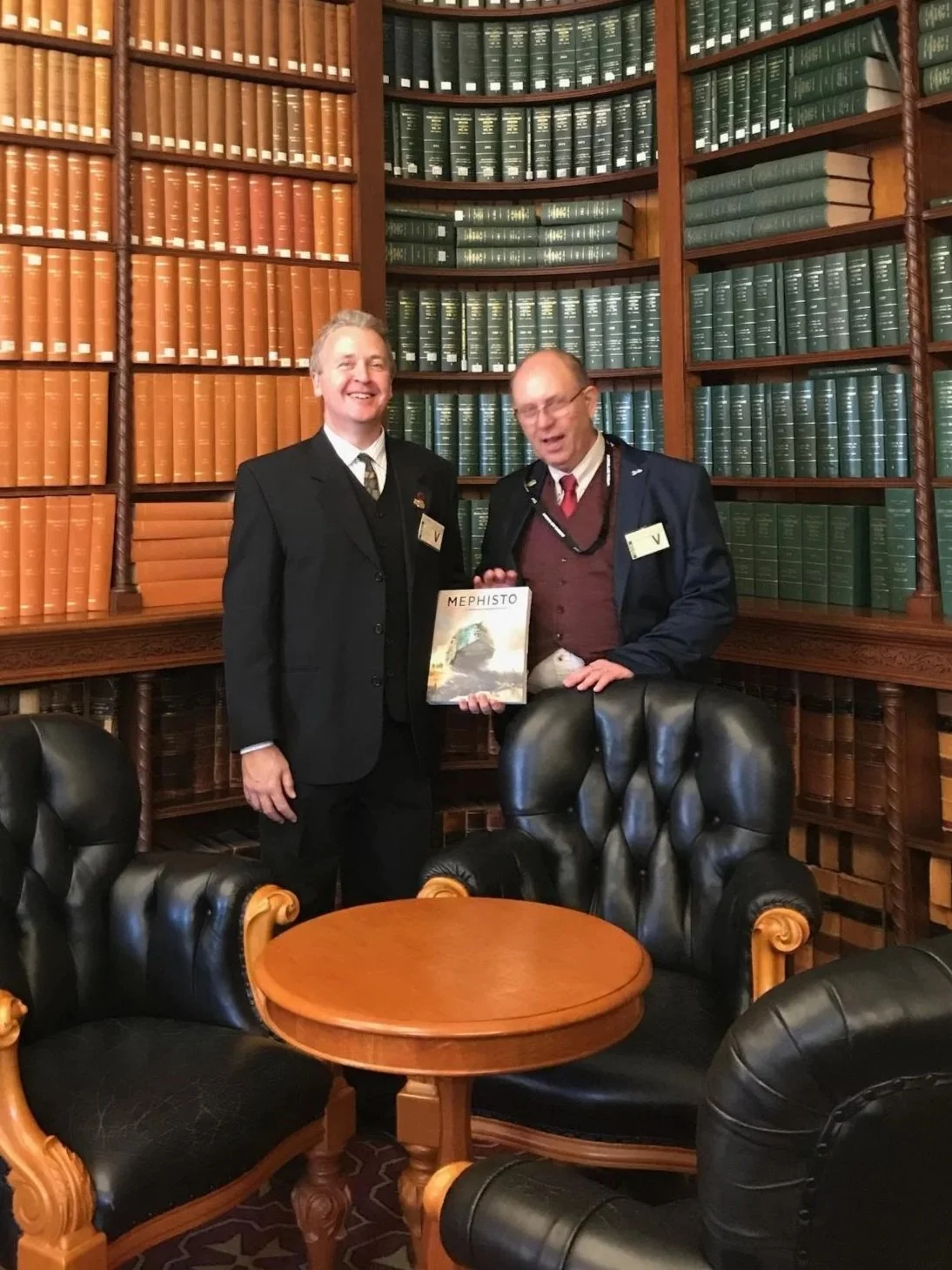
The day that Greg Czechura and Jeff were involved with the Queensland Museum Mephisto book launch, July 2018. This photo was taken at the Queensland Parliamentary Library Room by a friend and MP, Chris Whiting, who invited Greg and Jeff to cross the river to do some meet and greets with MPs and Ministers of the then State Labor Government.
I also had the pleasure with working with the wonderful Publications and Photography team at Queensland Museum. With my co-author Greg Czechura (pictured above), I produced two books as part of the commemorations for the centenary of WW1. Firstly, Mephisto: Technology, War and Remembrance. This book is a massive tome covering this global conflict and highlighting the many stories associated with one of Museum’s most significant social history collection objects, Mephisto the sole surviving German WW1 A7V tank. This armoured vehiclemachinery was captured and recovered on the Western Front by Queenslanders and Tasmanians of the 26th Battalion AIF near Villers-Bretonneux in July 1918. The book was in turn launched in July 2018 [see above image] for the centenary of Mephisto’s capture and recovery. Soon after, The ANZAC Legacy was released in conjunction with QM’s new commemorative Anzac Gallery (November 2019). Working as part of this small dynamic team, and writing collaboratively, was a real highlight in my career as an historian.
One last leap of faith with the family saw us all move interstate in early 2020, where I have continued to explore roles and opportunities as an historian in Canberra. Firstly, in heritage for the Commonwealth, then with Commemorations with the Department of Veterans’ Affairs. At the present juncture am back once more working in cultural heritage for a private consultancy.
Looking back over my several decades as a professional historian, while I have certainly not had the fortune to fall into long-term or established positions, I can most definitely say I have had amazing and diverse experiences working across a wide array of history and heritage. To transpose the words of a song by one of my favourite musicians Trent Reznor, ‘’maybe I am where I belong.’
Through my personal recall and reflection of life as a historian, I now encourage our branch associations and members to give serious thought as to how they might like to celebrate or document their own journeys with our national body. I look forward to hearing about any oral interviews or stories created with members who helped kick start this PHA journey, future contributions to Historia as well as submissions for our professional journal Circa, not to mention web-additions to the national or branch websites and other activities.
Let us all celebrate 30 years of PHA from August this year and on into 2027 – Happy Birthday PHA!
Jeff Hopkins-Weise
President, PHA